Reflective Roofing Materials: Benefits, Savings, and Costs
Reflective Roofing Materials: Benefits, Savings, and Costs
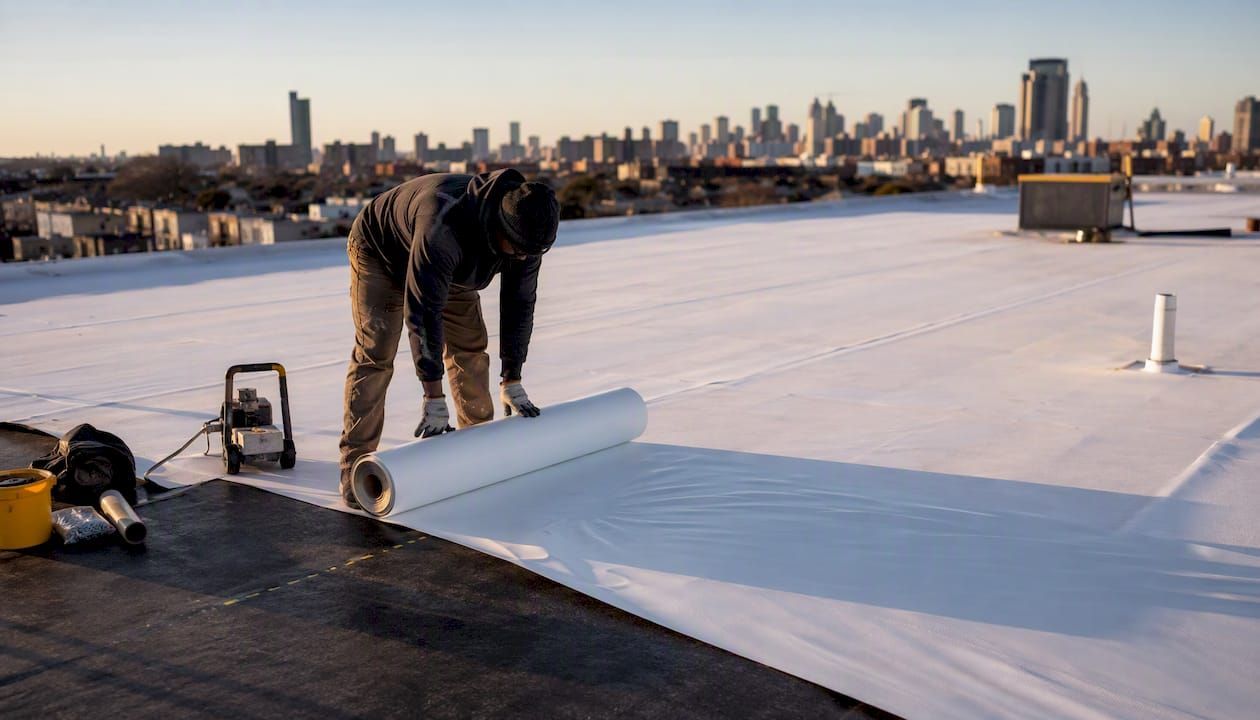
Reflective roofing materials reliably cut roof surface temperatures, reduce cooling energy use, lower peak demand charges, and often extend roof life. For buildings with meaningful cooling loads, especially in hot, sunny climates, they are worth serious consideration. Research across multiple building types puts cooling energy savings in a wide range of 2%–40%, with an industry average near 20%. The spread reflects real differences in climate, building type, and insulation level, not uncertainty about whether the technology works.
The primary reflective roofing material benefits facility managers and property owners care about most:
- Lower cooling costs: Reduced heat gain through the roof deck means the HVAC system runs less, directly cutting electricity bills.
- Reduced peak demand: Less heat entering the building during the hottest part of the day means lower peak demand, which matters if your utility bills include demand charges.
- Improved occupant comfort: Top-floor spaces and buildings with limited insulation see the most noticeable temperature improvement.
- Extended roof service life: Lower surface temperatures reduce thermal cycling stress on membranes and coatings, slowing material degradation.
Key Takeaways
climates.
| Point | Details |
|---|---|
| Savings range is wide but real | Cooling energy reductions of 2%–40% depend on climate, insulation, and building type; the industry average is near 20%. |
| Use aged SR in every model | CRRC-rated aged solar reflectance values, not initial values, give accurate payback projections and support incentive documentation. |
| Coat only on healthy substrates | A coating makes sense only when a moisture survey confirms no wet insulation and at least 5 years of remaining membrane life remain. |
| Check CRRC and ENERGY STAR first | Confirm CRRC listings and ENERGY STAR qualification before procurement to protect rebate eligibility and warranty validity. |
| Upstateroofingpros covers the full scope | Upstateroofingpros provides moisture surveys, reflectance audits, coating application, TPO/PVC replacement, and maintenance plans across Northern California. |
What makes a roof "cool" — and which metrics actually matter?
The term cool roof is the recognized industry label for any roofing system that reflects more sunlight and releases absorbed heat more effectively than a standard dark roof. The performance comes down to three measurable properties you should pull from every product data sheet before making a decision.
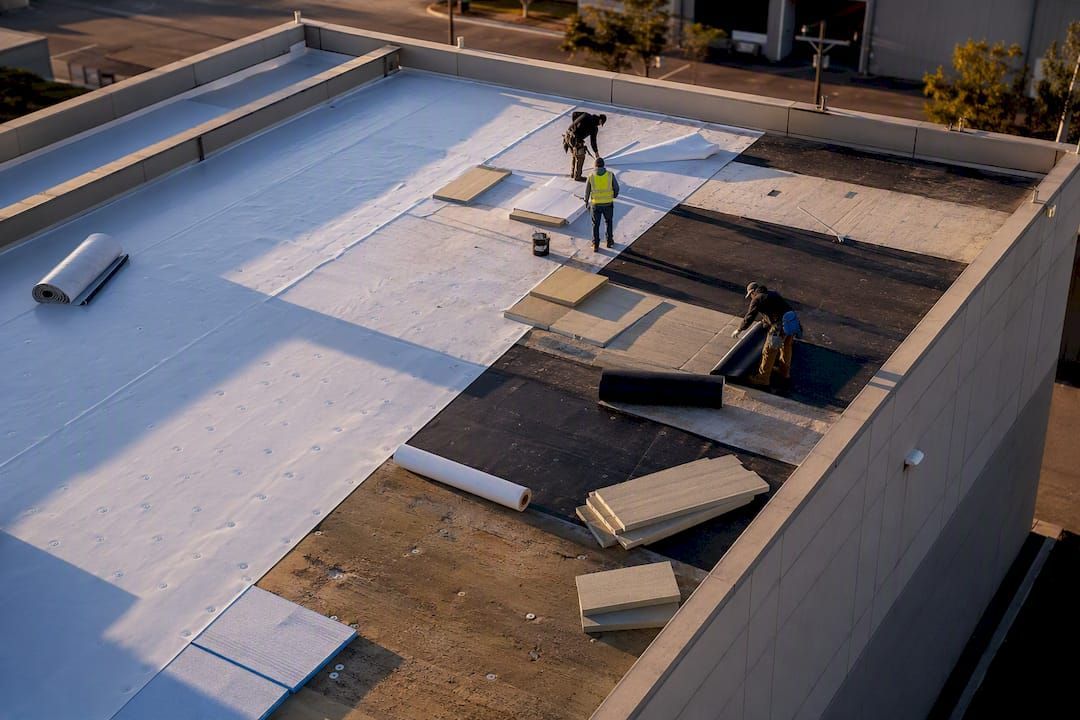
Solar reflectance (SR) , also called albedo, is the fraction of incoming solar energy the surface reflects. It runs from 0 to 1. A standard dark built-up roof typically measures SR 0.05–0.20. A white single-ply membrane or coating can reach SR 0.70–0.90. That gap is what produces the surface temperature differences of up to 50°F documented by LBNL's Heat Island Group.
Thermal emittance (TE) measures how efficiently the roof radiates absorbed heat back to the sky, also on a 0-to-1 scale. Most non-metallic roofing materials score 0.85–0.95, so emittance rarely differentiates products unless you are comparing bare metal (which can score as low as 0.05 without a coating). LBNL confirms that both SR and TE determine a roof's overall cooling effectiveness, which is why neither number alone tells the full story.
Solar Reflectance Index (SRI) combines SR and TE into a single number calibrated so that a standard black surface scores 0 and a standard white surface scores 100. SRI makes it easier to compare products across different material families. A white TPO membrane might carry an SRI of 104–110; a dark gravel surface might score below 10.
One critical distinction: initial versus aged reflectance. Products are rated at installation, but weathering, dirt, and biological growth reduce SR over time. The Cool Roof Rating Council (CRRC) publishes both initial and three-year aged values in its Rated Products Directory. Always use the aged SR when modeling energy savings.
| Roof Type | Typical Initial SR | Typical Aged SR | Approximate SRI |
|---|---|---|---|
| Standard dark BUR | 0.05–0.10 | 0.05–0.10 | 0–5 |
| Gray EPDM | 0.20–0.25 | 0.05–0.20 | 10–20 |
| White TPO / PVC membrane | 0.70–0.85 | 0.55–0.70 | 104–110 |
| White acrylic coating | 0.75–0.85 | 0.35–0.55 | 104–110 |
| Cool-color metal panel | 0.35–0.55 | 0.35–0.55 | 40+ |
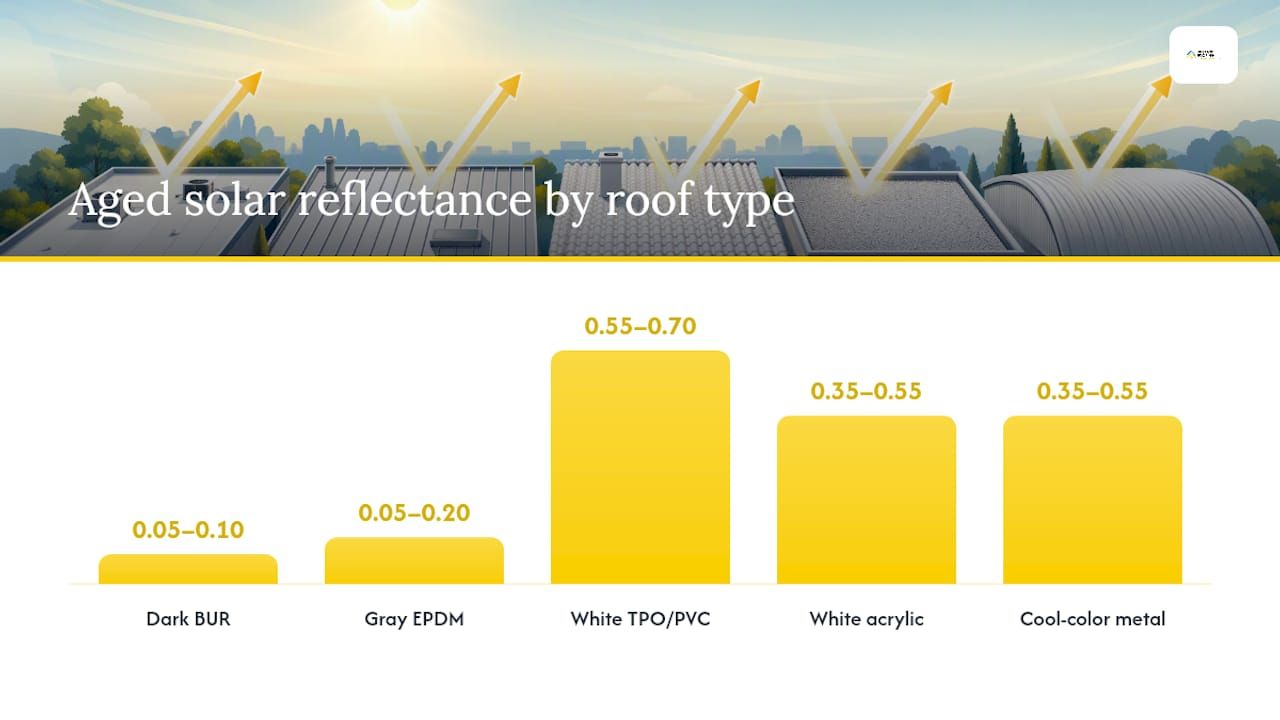
Color alone does not guarantee performance. Cool-color pigment technology uses near-infrared-reflective pigments to give darker-toned products meaningfully higher SR than a conventionally pigmented product of the same color. A dark-brown metal panel with cool pigments can reflect substantially more solar energy than its appearance suggests.
How reflective roofs reduce energy use — and what the numbers look like
The mechanism is straightforward. That heat conducts through the roof assembly into the conditioned space below, adding directly to the cooling load. A high-reflectance roof bounces most of that energy back before it ever enters the building.
DOE guidance documents that a cool roof can stay more than 50°F cooler than a conventional dark roof under sunny summer conditions. That temperature difference reduces the thermal gradient driving heat into the building, which cuts the cooling load and the time the HVAC system runs at peak capacity. Smaller peak loads also mean lower demand charges and, over time, the possibility of right-sizing replacement equipment.
Savings across the literature range from 2% to over 40% in cooling energy, with the industry average near 20%. The wide range is not a flaw in the data. A well-insulated office building in Minnesota will see modest savings; a single-story warehouse with R-11 insulation in Sacramento's Central Valley can see savings at the high end of that range. Building geometry, insulation level, and local climate drive the outcome more than product choice alone.
A simple example helps frame the decision. Consider a 20,000 sq. ft. low-slope commercial roof in Northern California. At a coating cost of $1.50–$2.00 per sq. ft. (roughly $30,000–$40,000 installed), simple payback lands in the 8–11 year range before incentives.
Pro Tip: When modeling savings for a capital proposal, always use the CRRC aged solar reflectance value, not the initial value. Using aged SR gives a more defensible number for reserve-fund planning and incentive documentation.
The DOE/EERE Cool Roof Guide also notes that reduced peak loads can allow smaller cooling equipment at replacement, which adds a capital cost benefit that rarely appears in simple payback calculations but matters in a full lifecycle analysis.
Which reflective roofing materials fit your roof type?
Reflective roofing covers several distinct product families. Matching the right one to your roof type and project goal is where most of the practical decision-making happens.
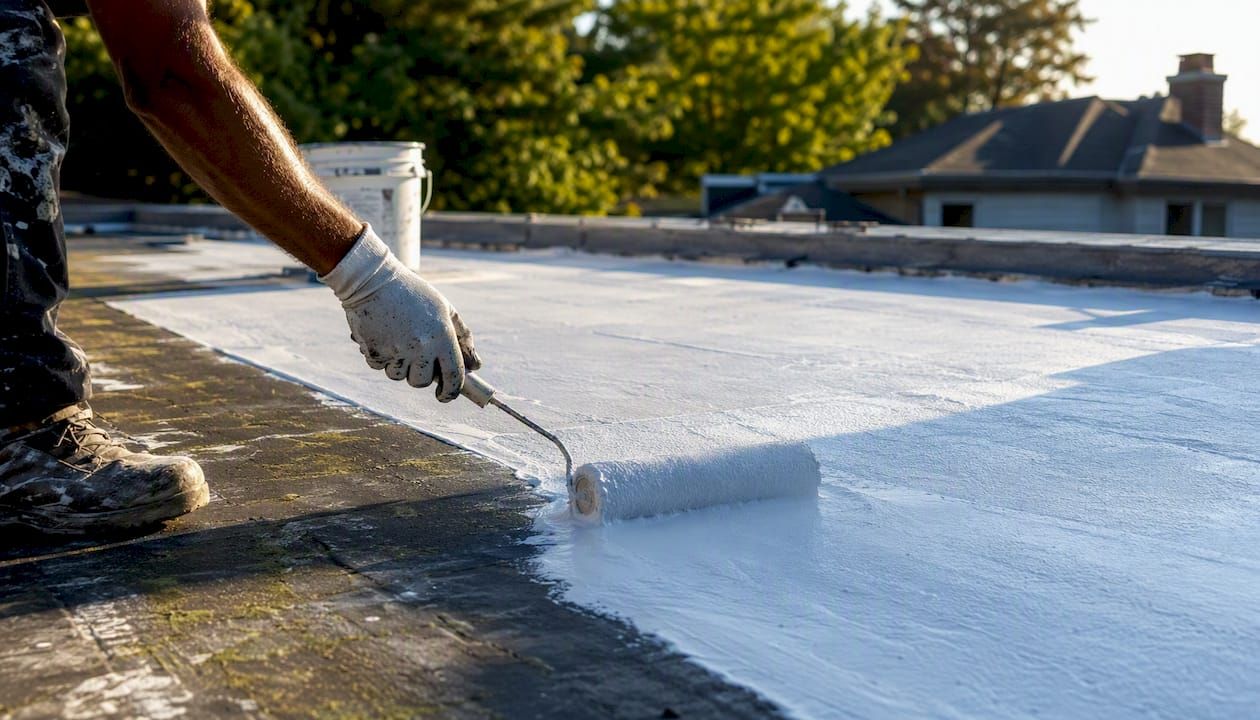
Reflective coatings (acrylic and silicone) are applied over an existing membrane or substrate. Acrylic coatings perform well in low-ponding environments and typically last 5–12 years depending on climate and maintenance. Silicone coatings tolerate standing water better, making them the preferred choice on low-slope roofs with drainage limitations. Both are the least-cost retrofit path when the substrate has adequate remaining life. They do not reset structural service life.
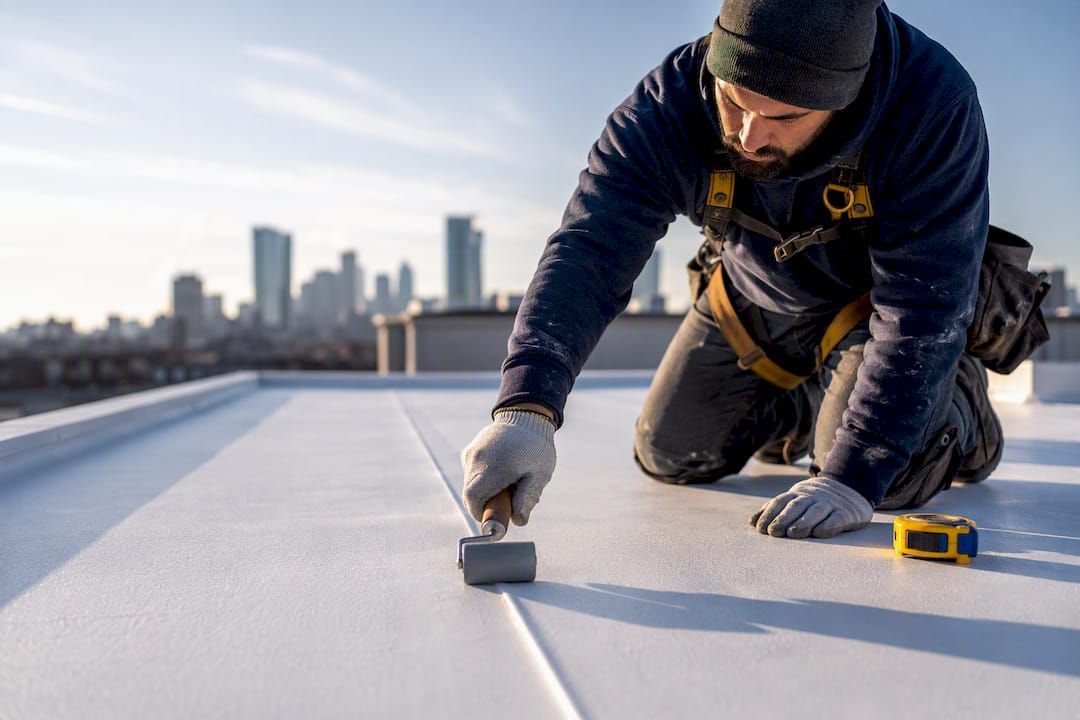
Single-ply membranes (TPO and PVC) are the dominant choice for new commercial low-slope construction and full replacement projects. Both carry high initial SR values (typically 0.70–0.85) and are available in ENERGY STAR-qualified versions. TPO is generally less expensive than PVC; PVC offers better chemical resistance. Installed lifespans of 20–30 years are realistic with proper maintenance.
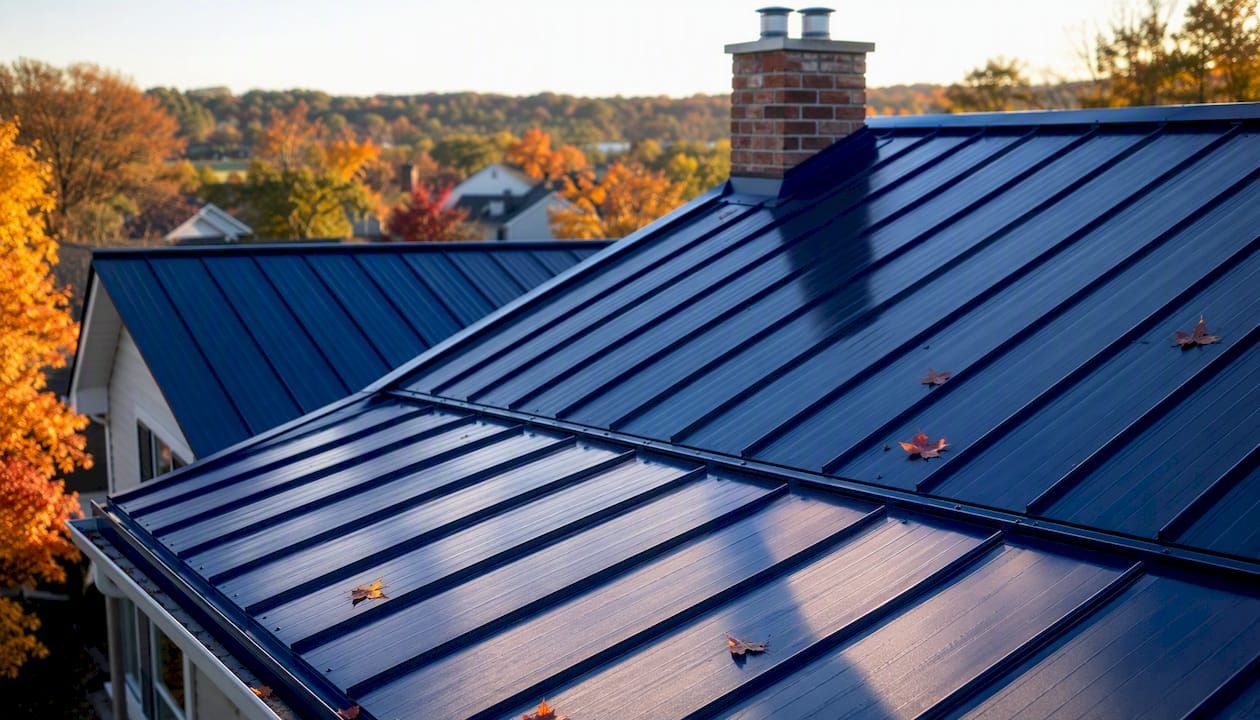
Factory-finished metal roofing suits steep-slope and standing-seam applications. With cool-color pigment coatings, metal panels can achieve SR values of 0.35–0.55 and carry 40+ year lifespans. Metal is the highest upfront cost option but the lowest lifecycle cost per year for long-hold assets. It also resets structural service life completely.
Cool shingles and tiles bring reflective benefits to residential and steep-slope commercial applications. ENERGY STAR-rated cool shingles use the same near-infrared-reflective pigment technology as metal panels. They are a practical upgrade for property owners who want improved energy performance without changing the roof profile. Roofing upgrades that increase home value often include cool shingle options precisely because they combine aesthetics with measurable energy savings.
Pro Tip: A coating makes financial sense when the existing membrane has at least 5 years of remaining service life and passes a moisture survey with no wet insulation. If the moisture survey finds saturated insulation or the membrane is already delaminating, coating over the problem delays the inevitable and voids most coating warranties. Replacement is the right call.
For a deeper look at how material families compare on durability and cost across commercial roofing applications, the tradeoffs between coating and replacement become clearer in the context of full lifecycle cost.
What does a reflective roof actually cost, and when does it pay back?
Cost varies significantly by product type, substrate condition, and roof access. Coatings are the entry point; full replacement with a reflective membrane is a larger capital event.
Typical installed cost ranges (illustrative, not vendor quotes):
- Reflective coating (acrylic or silicone): $1.00–$2.50 per sq. ft. depending on number of coats, primer requirements, and surface prep.
- TPO or PVC single-ply replacement: $5.00–$9.00 per sq. ft. for a standard commercial installation.
- Cool metal roofing (standing seam): $10.00–$18.00 per sq. ft. installed, varying by panel profile and substrate.
The factors that move costs most are substrate condition (tear-off adds cost), roof access complexity, and square footage. A roof that needs repairs before coating adds to the effective cost per sq. ft.
Expected service life shapes the real cost-per-year picture. Acrylic coatings last roughly 5–12 years; silicone coatings can run longer in ponding environments. TPO and PVC membranes realistically deliver 20–30 years. Metal roofing, properly maintained, can exceed 40 years. Capital planning guidance from industry practitioners makes the point clearly: coatings cost less upfront but do not reset structural service life, while replacement resets the clock and the reflective premium at replacement is often modest relative to total project cost.
| TPO replacement, conservative (15% savings) | 20,000 sq. ft. | — | — | 40+ | years | TPO replacement, optimistic (30% savings) | 20,000 sq. ft. | — | — | 20–30 years |
Assumes $18,000 annual cooling cost baseline. Payback does not include utility rebates, demand charge reductions, or extended roof life value.
The replacement payback numbers look long in isolation, but they ignore that the roof needed replacing anyway. The incremental cost of choosing a reflective membrane over a standard dark one at replacement is often $0.25–$0.75 per sq. ft. On that incremental basis, payback is typically under 3 years in a warm climate.
Pro Tip: Build your payback model with aged reflectance values and include an annual cleaning cost of roughly $0.05–$0.10 per sq. ft. Research on reflectance attenuation and cleaning ROI shows that cleaning costs are small relative to the energy savings preserved over a full coating lifecycle, but omitting them from the model produces an overstated payback.
Where do reflective roofs work best — and where do they fall short?
Climate is the dominant variable. The greatest net benefit lands on buildings in hot, sunny climates with long cooling seasons, high cooling loads, and limited roof insulation. Northern California, the Southwest, and the Southeast are strong candidates. The Pacific Northwest and upper Midwest see smaller net benefits.
Key factors that increase the benefit:
- Single-story or low-rise buildings where the roof represents a large fraction of the building envelope.
- Buildings with R-15 or less of roof insulation (the lower the insulation, the more heat the roof assembly transfers).
- Facilities with high internal heat loads (data centers, commercial kitchens, manufacturing) that already run cooling year-round.
- Urban locations subject to the heat island effect, where ambient temperatures are already elevated.
The winter heating penalty is real but usually modest. In most U.S. climates, a reflective roof that reduces heat gain in summer also reduces passive solar heat gain in winter, slightly increasing heating costs. DOE analysis shows this penalty is generally smaller than summer savings in climates south of roughly the 40th parallel. In northern climates with short cooling seasons and long heating seasons, the net annual benefit shrinks and may turn negative for some building types. Run the numbers for your specific climate zone before committing.
Insulation level interacts with the benefit in a counterintuitive way. A highly insulated roof (R-30+) already limits heat transfer in both directions, so the marginal benefit of adding reflectance is smaller. The biggest wins come from poorly insulated roofs where the thermal barrier is weak.
Glare is a legitimate concern for buildings adjacent to taller structures or in dense urban settings. A white membrane can reflect intense light onto neighboring windows or occupied terraces. Cool-color products, which achieve moderate SR values (0.35–0.55) in non-white colors, reduce glare while retaining meaningful reflective benefit. The EPA's urban heat island analysis notes that wide cool-roof adoption at the community scale reduces outdoor temperatures, slows smog formation, and cuts power-plant emissions, but individual building decisions should account for site-specific glare impacts.
Rooftop PV arrays and reflective roofing can coexist, but the interaction needs thought. Panels shade portions of the roof, reducing the reflective benefit in those zones. High-reflectance surfaces under bifacial panels can increase their output, but verify with the panel manufacturer before specifying a very high-SR surface beneath a PV array.
What ratings and incentives should you check before buying?
Product credentials and incentive eligibility are tightly linked. Getting the documentation right before procurement saves time and money.
Must-check product credentials:
- CRRC-rated solar reflectance and aged SR: The Cool Roof Rating Council maintains a Rated Products Directory with initial and three-year aged values for thousands of products. Use aged SR in your energy model and confirm the product is actively listed.
- Thermal emittance value: Confirm TE is listed on the CRRC data sheet, not just SR.
- SRI value: Some codes and incentive programs specify a minimum SRI rather than SR alone.
- ENERGY STAR listing: ENERGY STAR-qualified cool roofs meet minimum SR and aged SR thresholds set by the DOE. Many utility rebate programs require ENERGY STAR qualification as a condition of payment.
- Manufacturer warranty terms: Confirm the warranty covers reflectance performance, not just physical integrity, and note any maintenance requirements that affect warranty validity.
Incentive types to pursue:
- Utility rebates: Many California utilities offer per-sq.-ft. or calculated-savings-based rebates for CRRC-rated or ENERGY STAR-qualified cool roofs. Pre-approval before installation is typically required. EPA guidance on using cool roofs to reduce heat islands confirms that documentation and pre-approval are standard requirements.
- Local and municipal programs: Some California cities and counties offer additional incentives tied to heat island reduction goals. Check with your local building department and utility account manager.
- Federal tax provisions: Consult a tax advisor on current energy efficiency provisions that may apply to commercial roofing improvements.
Procurement checklist:
- Pull the CRRC product listing (initial SR, aged SR, TE, SRI).
- Confirm ENERGY STAR qualification if required for rebate eligibility.
- Request manufacturer warranty documentation and note maintenance requirements.
- Obtain pre-approval from the utility before installation begins.
- Document pre-install roof condition with photos and a moisture survey for warranty and incentive records.
Contractor checklist for installation and long-term maintenance
A reflective roof that is poorly installed or never cleaned will underperform its rated values within a few years. These are the items worth verifying at every stage.
Pre-installation condition checks:
- Infrared or nuclear moisture survey to locate wet insulation (wet insulation must be removed before coating or new membrane installation).
- Count of existing roof layers (most jurisdictions and manufacturers limit overlays; two layers is typically the maximum before tear-off is required).
- Membrane adhesion test: pull-test or probe to confirm the existing membrane is bonded and not delaminating.
- Remaining service life estimate: if less than 5 years of useful life remains, coating is not financially defensible. Roof lifecycle planning should inform this threshold.
Installation quality assurance:
- Surface must be clean, dry, and free of contaminants before primer or coating application.
- Primer application per manufacturer specification (skipping primer is the most common cause of early delamination).
- Wet-film thickness checks during application to confirm specified dry-film thickness will be achieved.
- Ambient temperature and humidity within manufacturer-specified application windows.
- Warranty registration completed and maintenance schedule documented.
Ongoing maintenance schedule:
- Annual visual inspection: check for ponding, membrane splits, lap seam separation, and coating erosion.
- Cleaning every 1–3 years depending on local soiling rates (biological growth, industrial fallout, dust). Scheduled cleaning written into a maintenance plan preserves reflectance and protects long-term savings.
- Spot reflectance checks at year 3–5 to confirm aged SR is tracking within expected range.
- Plan recoating at the end of the coating's rated service life, not after failure.
Questions to ask potential contractors:
- Can you provide CRRC product listings for the specific coating or membrane you are proposing?
- What moisture survey method do you use, and will you provide the report?
- What are the warranty maintenance requirements, and who is responsible for tracking them?
- Have you completed similar projects in this climate zone, and can you provide performance records?
Pro Tip: Write the aged solar reflectance assumption directly into the project specification and contract. If a contractor proposes a product with an aged SR of 0.45 and your energy model assumed 0.60, you will not get the savings you projected. Locking in the aged SR value protects both the energy model and the incentive documentation.
When I'd actually recommend a reflective roof
The case for a reflective roof is strongest when three conditions align: the building is in a warm climate with a real cooling load, the asset has a multi-year hold horizon that justifies the payback period, and the roof is either due for replacement or has enough remaining life to make a coating financially sound.
For buildings in Northern California, that combination is common. A warehouse, retail center, or multi-tenant office building with a low-slope roof and modest insulation is almost always a good candidate. The summer cooling season is long, electricity rates are high, and utility rebate programs are active.
Where I'd steer clients away from a coating: when the moisture survey finds wet insulation, when the membrane is already past its useful life, or when the building is in a climate where heating costs dominate. In those cases, a full replacement with a reflective membrane is the right capital decision. The incremental cost of choosing a white TPO over a standard gray membrane at replacement is small, and the payback on that incremental spend is fast.
The decision framework I'd use: start with a roof lifecycle review to establish remaining service life, run a simple payback sketch using aged SR values and local utility rates, check incentive eligibility before finalizing scope, and then decide whether coating or replacement is the right tool. Pairing that process with an incentive scoping conversation often changes the payback math enough to shift the decision.
Upstateroofingpros can assess, install, and maintain your reflective roof
Reflective roofing decisions involve real tradeoffs between coating and replacement, and the right answer depends on your specific roof condition, climate, and capital timeline. Upstateroofingpros handles every step of that process for property owners and facility managers across Northern California.

A site visit from Upstateroofingpros includes a moisture survey, a reflectance audit of the existing surface, and a simple payback sketch using your actual utility rates and CRRC-rated product data. From there, the team can apply reflective coatings, install TPO or PVC membranes, or complete a full roof replacement with a high-SR system. For buildings that need repairs before any coating work is viable, roof repair services address those conditions first. Upstateroofingpros also offers a roof maintenance plan that keeps cleaning and inspection on schedule, protecting reflectance performance and incentive documentation over the full coating lifecycle. Contact Upstateroofingpros to schedule your assessment and get the documentation your utility rebate program requires.
Sources
These authoritative resources back the figures and guidance in this article and provide tools for site-specific analysis.
Recommended
Recent Posts