
Types of Roofing Insulation for Commercial Buildings
Commercial roofing insulation is defined as the thermal barrier installed within a roof assembly to control heat transfer between a building's interior and the exterior environment. Choosing the right types of roofing insulation for commercial properties directly determines energy costs, HVAC lifespan, and code compliance. Properly insulated commercial roofs can cut annual heating and cooling consumption by 20%–30%. That range is not a rounding error. It represents tens of thousands of dollars per year for a mid-size facility. Standards like ASHRAE 90.1 and the International Energy Conservation Code (IECC) set minimum R-value targets that vary by climate zone, making material selection a legal obligation, not just a financial one.
1. What are the main types of commercial roofing insulation?
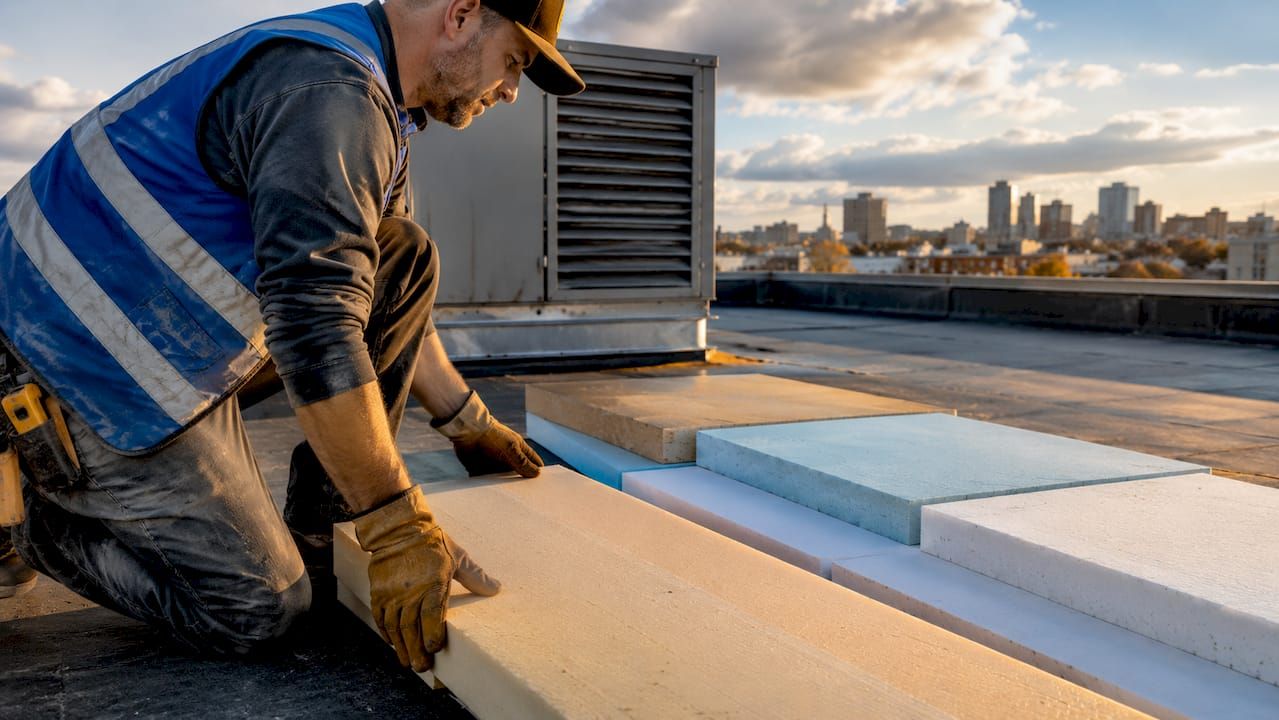
The six materials below cover the vast majority of commercial roof assemblies in use today. Each has a distinct performance profile, and none is universally superior.
Polyisocyanurate (Polyiso)
Polyiso is the most widely installed foam plastic insulation on low-slope commercial roofs in the United States. It delivers an aged LTTR R-value of 5.6 per inch, which is among the highest available in board form. Polyiso is approved for direct application to steel decks in many fire-rated assemblies, a distinction no other foam plastic insulation holds. That approval simplifies specification on the majority of commercial structures, which use steel framing.
One important caveat: Polyiso loses R-value in very cold temperatures. Facilities in northern climate zones should account for this in their energy modeling.
Extruded Polystyrene (XPS)
XPS provides approximately R-5.0 per inch and excels in moisture resistance and compressive strength. XPS outperforms EPS in both categories, which makes it the preferred choice for protected membrane or inverted roof assemblies where the insulation sits above the waterproofing layer and is exposed to water and foot traffic. Its higher cost is justified specifically in those assemblies. Using XPS on a standard low-slope roof where moisture exposure is controlled adds cost without a proportional performance benefit.
Expanded Polystyrene (EPS)
EPS offers R-3.8 to R-4.2 per inch depending on density and costs less per board foot than either Polyiso or XPS. It is vapor-permeable, which means it can dry out after moisture exposure rather than trapping water inside the assembly. EPS is widely used in tapered insulation systems because manufacturers can cut it to precise slopes at relatively low cost. Its lower compressive strength limits its use in high-traffic roof areas without a protective cover board.
Mineral Wool (Rock Wool)
Mineral wool is non-combustible, which makes it the default choice when fire codes require a non-foam plastic insulation layer. It also provides meaningful sound attenuation, a real benefit for facilities near airports, highways, or industrial operations. Its R-value per inch is lower than foam plastics, typically in the R-3.7 to R-4.2 range, so achieving code-required totals demands greater thickness. Mineral wool handles moisture well and does not support mold growth.
Spray Polyurethane Foam (SPF)
SPF delivers the highest R-value per inch of any common commercial insulation material, approximately R-6.5 per inch. It also creates a seamless air barrier across the entire roof surface, eliminating the joints and seams where thermal bridging and air leakage occur in board systems. SPF is particularly effective on roofs with many penetrations, such as HVAC curbs, pipes, and drains, because the foam conforms around each obstruction. It requires a protective coating to resist UV degradation, which adds to the total installed cost.
Pro Tip: SPF works best as a complete roofing system, not just an insulation layer. Budget for the protective topcoat from the start, or the foam will degrade within two to three seasons.
Composite and Tapered Insulation Systems
Composite and tapered systems combine multiple insulation types to meet slope, drainage, and thermal performance goals simultaneously. A common configuration uses a base layer of Polyiso for thermal performance, topped with a tapered EPS layer to create positive drainage, then finished with a cover board for surface protection. These systems add design complexity but solve problems that no single material can address on large flat roofs. Upstateroofingpros regularly specifies composite systems for commercial clients whose roofs require both code-compliant R-values and reliable water drainage.
2. How do R-values and thermal performance vary among insulation types?
R-value measures thermal resistance per unit of thickness. A higher R-value means less heat moves through the material. The table below compares the per-inch R-values of the most common commercial insulation materials.
| Material | R-value per inch | Key strength |
|---|---|---|
| Spray Polyurethane Foam | ~6.5 | Seamless air barrier, highest thermal resistance |
| Polyisocyanurate (Polyiso) | ~5.6 (aged LTTR) | Fire code approval for steel decks |
| Extruded Polystyrene (XPS) | ~5.0 | Moisture resistance, compressive strength |
| Expanded Polystyrene (EPS) | 3.8–4.2 | Cost-effective, vapor-permeable, tapered systems |
| Mineral Wool | 3.7–4.2 | Non-combustible, sound attenuation |
The DOE recommends R-values from R-20 to R-38 for commercial roofs depending on climate zone. That range means a facility in Sacramento, California, faces a different code target than one in Minneapolis, Minnesota. ASHRAE 90.1 and the IECC define the specific minimums for each zone, and local jurisdictions sometimes adopt stricter requirements on top of those baselines.
Achieving R-38 with Polyiso at R-5.6 per inch requires roughly 6.8 inches of insulation. That thickness affects roof height, parapet clearance, and sometimes door and window head heights. Facility managers need to factor roof assembly depth into the specification process, not just the R-value target.
Pro Tip: Always specify insulation R-values using aged or LTTR values, not initial values. Some foam plastics lose thermal resistance as blowing agents dissipate over time. The aged value is what you will actually get after the first year of service.
3. What factors affect commercial roof insulation material selection?
Thermal resistance is only one variable. The following factors determine which material is actually right for a given building.
Moisture management. Water infiltration degrades insulation performance and causes structural damage. XPS resists moisture absorption better than EPS, which is why XPS is preferred in inverted roof assemblies where the insulation is exposed to standing water. For standard assemblies with a membrane above the insulation, EPS or Polyiso performs adequately when edge detailing is correct.
Compressive strength. Roofs that support HVAC equipment, maintenance foot traffic, or rooftop amenities need insulation with sufficient compressive strength to resist deformation under load. XPS and high-density EPS handle these loads well. Standard Polyiso boards require a cover board in high-traffic areas to prevent surface damage.
Fire code requirements. Polyiso holds fire code approvals that other foam plastics do not. When a project requires foam plastic insulation directly on a steel deck, Polyiso is typically the only compliant option. Mineral wool satisfies the most stringent fire codes because it is non-combustible.
Lifecycle cost vs. upfront expense. EPS costs less per board foot than XPS or Polyiso, but the right choice depends on the total cost over the roof's service life. R-value directly affects HVAC operational costs and equipment longevity. Underinsulating to save money upfront often results in HVAC overexertion and premature equipment replacement, which costs far more than the insulation savings.
Continuous insulation and thermal bridging. Effective roof insulation requires continuous coverage and meticulous edge detailing. Gaps, offsets at joints, and inadequate edge sealing create pathways for heat loss that reduce the assembly's effective R-value below what the material spec promises.
Roof assembly type. Protected membrane roofs, conventional assemblies, and hybrid systems each place insulation in a different position relative to the membrane and deck. The assembly type determines which materials are physically and code-compliant options for a given project.
4. How installation methods affect insulation performance
The way insulation is attached to the deck determines how much of its rated R-value the building actually receives.
Mechanically attached systems use fasteners driven through the insulation boards into the deck. Thermal bridging through fasteners and joints can reduce the rated R-value by 20%–40% in mechanically attached assemblies. That loss is frequently overlooked when comparing material costs. A building specified at R-30 may perform at R-18 to R-24 if fastener density is high and no thermal break is included.
Adhered systems bond insulation boards to the deck with adhesive, eliminating most fastener-related thermal bridging. They cost more to install but deliver performance closer to the material's rated R-value. Adhered systems also resist wind uplift effectively when the adhesive is applied correctly.
Ballasted systems hold insulation in place with stone or pavers rather than fasteners or adhesive. They are simple to install and allow easy access for maintenance, but the added dead load requires structural verification before specification.
Tapered insulation boards create slope across an otherwise flat deck to direct water toward drains. They are cut to precise angles and installed as part of the base insulation layer. Proper slope prevents ponding water, which is one of the leading causes of membrane failure and insulation saturation on commercial roofs. Upstateroofingpros uses tapered systems on large flat roofs where drainage is a documented problem.
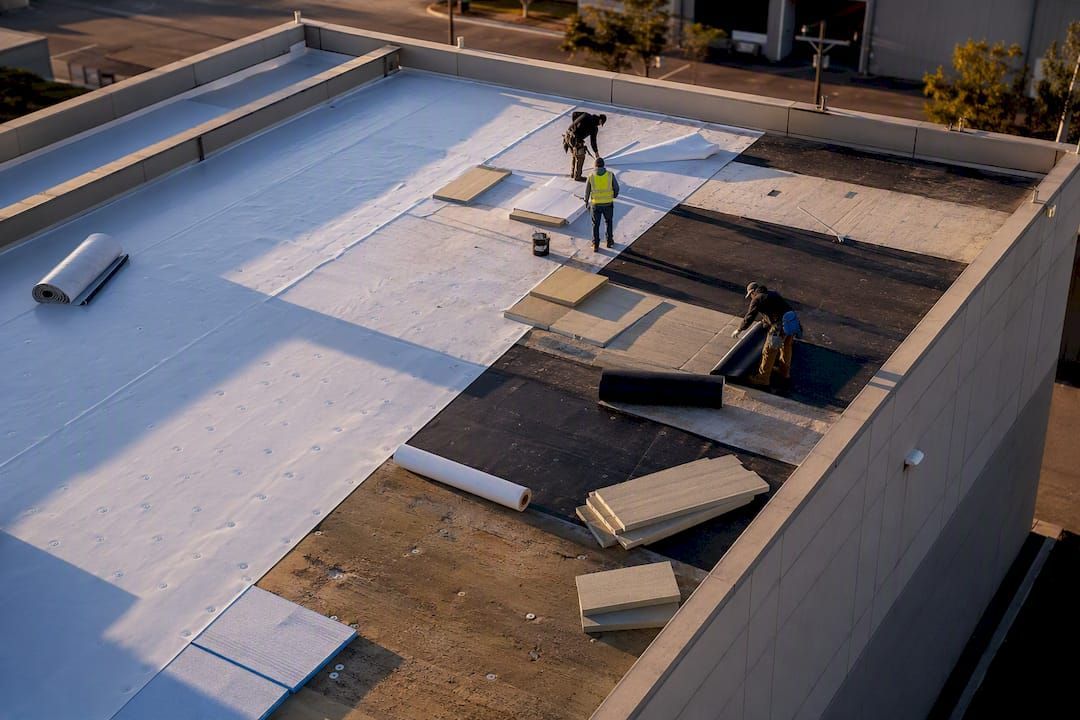
Quality control during installation matters as much as material selection. Seams between boards must be staggered and offset, vapor retarders must be detailed correctly at edges and penetrations, and cover boards must be secured before the membrane goes down. A commercial roof inspection after installation confirms that the assembly was built to spec before the membrane conceals the insulation layer permanently.
Key takeaways
The best commercial roofing insulation is the one that matches your climate zone, roof assembly type, fire code requirements, and lifecycle cost model, not simply the material with the highest R-value per inch.
| Point | Details |
|---|---|
| R-value targets vary by climate | DOE recommends R-20 to R-38; verify against ASHRAE 90.1 and local IECC requirements. |
| Polyiso leads for low-slope roofs | Its fire code approval for steel decks makes it the default foam plastic for most commercial assemblies. |
| Thermal bridging cuts real performance | Mechanically attached systems can lose 20%–40% of rated R-value through fasteners and joints. |
| XPS premium is situational | Its moisture resistance justifies higher cost only in inverted or protected membrane assemblies. |
| Insulation affects HVAC lifespan | Underinsulating forces HVAC systems to overwork, accelerating equipment wear and replacement costs. |
What I've learned after years of specifying commercial insulation
The most expensive mistake I see on commercial roofing projects is treating R-value as a checkbox rather than a system variable. A facility manager approves a Polyiso spec that hits R-30 on paper, the contractor installs it with a high-density mechanical attachment pattern, and the building ends up performing at R-20 because nobody accounted for thermal bridging. The HVAC system compensates, energy bills climb, and the equipment wears out years ahead of schedule.
The second most common mistake is paying XPS prices on a roof that does not need XPS. XPS moisture resistance is genuinely valuable in an inverted roof assembly. On a standard low-slope roof with a properly installed membrane above the insulation, that premium buys almost nothing. EPS or Polyiso performs just as well at a lower cost.
What actually works is treating insulation as part of an energy model, not a material spec. Feed your climate zone, roof area, and HVAC capacity into a basic energy model. Use the energy efficiency data to set a target R-value that pays back within your capital planning horizon. Then choose the material and installation method that delivers that R-value reliably over the roof's service life, accounting for thermal bridging, moisture exposure, and maintenance access.
R-value is a critical input to operational expense modeling, not just an engineering specification. The facility managers who understand that distinction make better decisions and run better buildings.
— Cesar
Upstateroofingpros: commercial roofing insulation done right
Selecting the right insulation material is only half the job. Correct installation, code-compliant detailing, and ongoing maintenance determine whether that material performs as specified for the next 20 years.
Upstateroofingpros serves commercial property owners and facility managers across Sacramento, Roseville, and surrounding areas with fully licensed crews experienced in every insulation type covered here. Whether your building needs a complete roof replacement with upgraded insulation, targeted roof repairs to address failing sections, or a roof maintenance plan to protect your current assembly, the team at Upstateroofingpros brings the technical knowledge to get it right the first time. Contact Upstateroofingpros to schedule a commercial roof assessment and get a clear picture of where your insulation stands.
FAQ
What is the best insulation type for most commercial roofs?
Polyisocyanurate (Polyiso) is the industry-standard choice for low-slope commercial roofs because it delivers a high aged R-value of 5.6 per inch and holds fire code approval for direct application to steel decks.
How much can insulation reduce commercial energy costs?
Properly installed commercial roof insulation can reduce annual heating and cooling energy consumption by 20%–30%, depending on climate zone and building usage patterns.
What R-value does a commercial roof need to meet code?
The DOE recommends R-20 to R-38 for commercial roofs based on climate zone. The exact minimum is set by ASHRAE 90.1 and the IECC, and local jurisdictions may require higher values.
Does installation method affect how well insulation performs?
Thermal bridging through fasteners in mechanically attached systems can reduce the rated R-value by 20%–40%. Adhered systems minimize this loss and deliver performance closer to the material's specification.
When does XPS insulation make sense over EPS or Polyiso?
XPS is the right choice in protected membrane or inverted roof assemblies where the insulation is exposed to moisture and heavy foot traffic. For standard assemblies with a membrane above the insulation, EPS or Polyiso provides comparable performance at lower cost.