

How to Hire a Licensed Roofing Contractor in 2026

June 28, 2026

Share this article

How to Hire a Licensed Roofing Contractor in 2026

A licensed roofing contractor is a credentialed professional who holds a state-verified license, carries general liability insurance, and maintains workers' compensation coverage to legally perform roofing work on your property. Hiring the wrong contractor costs you more than money. Failed inspections, voided warranties, and structural damage from poor workmanship are real outcomes when you skip proper vetting. This guide gives homeowners and property managers a clear, step-by-step process to find certified roofers, verify their credentials, and sign a contract with confidence.

What credentials to verify before you hire a licensed roofing contractor

The four non-negotiable credentials are a state-verified contractor license, general liability insurance, workers' compensation coverage, and recent client references. Skipping any one of these creates real legal and financial exposure for you as a property owner.

State contractor license

Every state maintains a contractor licensing board where you can search a contractor's license number, confirm its status, and check for disciplinary actions. The license type matters as much as the license itself. License categories vary by jurisdiction. Some areas accept a general contractor license for roofing work, while others require a roofing-specific trade license. Using a contractor with the wrong license category can result in denied permits or voided manufacturer warranties. Always confirm the license type matches the scope of your project before you proceed.

General liability and workers' compensation

General liability insurance protects your property if the contractor causes accidental damage during the job. Reputable platforms require a minimum of $1 million in liability coverage before listing any contractor. Workers' compensation is equally non-negotiable. Without it, you could be held financially responsible if a worker is injured on your roof. Ask for certificates of insurance directly from the contractor's insurer, not just a copy the contractor hands you.

References and BBB history

Checking BBB complaint history tells you how a contractor handles disputes, not just whether they do good work. A contractor with no complaints is ideal, but one who resolves complaints professionally is still a viable candidate. Beyond the BBB, ask for at least three recent client references and contact each one. Ask each reference specifically about budget adherence, timeline accuracy, and overall satisfaction. Vague answers or reluctance to provide references are red flags.

Pro Tip: Search your state contractor licensing board's website directly. Most boards let you verify license status, expiration date, and complaint history in under two minutes.

How do you find and evaluate licensed roofing contractors near you?

Finding the best roof contractor near you starts with using directories that verify license and insurance before listing a contractor. Lead aggregator sites collect your contact information and sell it to contractors without vetting their credentials. Verified directories, by contrast, require proof of license and insurance as a condition of listing.

Questions to ask every contractor

Before you schedule an on-site estimate, ask each contractor these questions:

  1. What is your license number, and in which state is it issued?
  2. Can you provide a certificate of insurance directly from your insurer?
  3. Do you carry a general contractor license or a roofing-specific trade license?
  4. Will you pull the required permits for this project?
  5. Do you hold any manufacturer certifications, such as GAF certification?
  6. What warranty do you offer on labor, and what does it cover?
  7. Can you provide three references from projects completed in the past 12 months?

These questions filter out unqualified contractors quickly. A contractor who hesitates on the permit question or cannot name their license number on the spot is not ready for your project.

Manufacturer certifications and warranty coverage

Manufacturer certifications give you access to extended warranty coverage that unlicensed or uncertified contractors cannot offer. A GAF-certified contractor, for example, can provide a system warranty that covers both materials and installation. That coverage disappears if the installer is not certified. When you evaluate contractors, treat manufacturer certification as a bonus credential that signals higher installation standards.

On-site estimates and local code knowledge

Schedule at least two on-site estimates before making a decision. A contractor who quotes over the phone without inspecting your roof is guessing. Local knowledge matters too. A contractor familiar with your region's building codes and climate conditions will specify the right materials and installation methods. A professional roof inspection before the estimate gives you an independent baseline to compare bids against.

Pro Tip: Watch for contractors who pressure you to sign the same day, offer unusually low bids, or ask for full payment upfront. These are the three most common warning signs of a scam or unqualified operator.

Step-by-step process to hire a roofing contractor with confidence

A clear process prevents the most common hiring mistakes. Follow these steps in order.

  1. Document your roofing needs. Write down the roof's age, material type, visible damage, and any recent repairs. This information helps contractors give you accurate bids.
  2. Request written bids from at least three contractors. Written estimates must include labor costs, material specifications, taxes, payment terms, and warranty details. Any bid missing these items is incomplete.
  3. Verify credentials independently. Confirm the license number on your state board's website. Call the insurer listed on the certificate to confirm the policy is active.
  4. Confirm permit handling. Licensed contractors pull permits and manage inspections as part of the job. If a contractor asks you to pull your own permit, that is a serious warning sign.
  5. Review the contract in full before signing. The contract must specify the scope of work, start and end dates, payment schedule, and warranty terms.
  6. Avoid paying more than 10–30% upfront. A reasonable deposit is standard. Full payment before work begins gives you no leverage if problems arise.

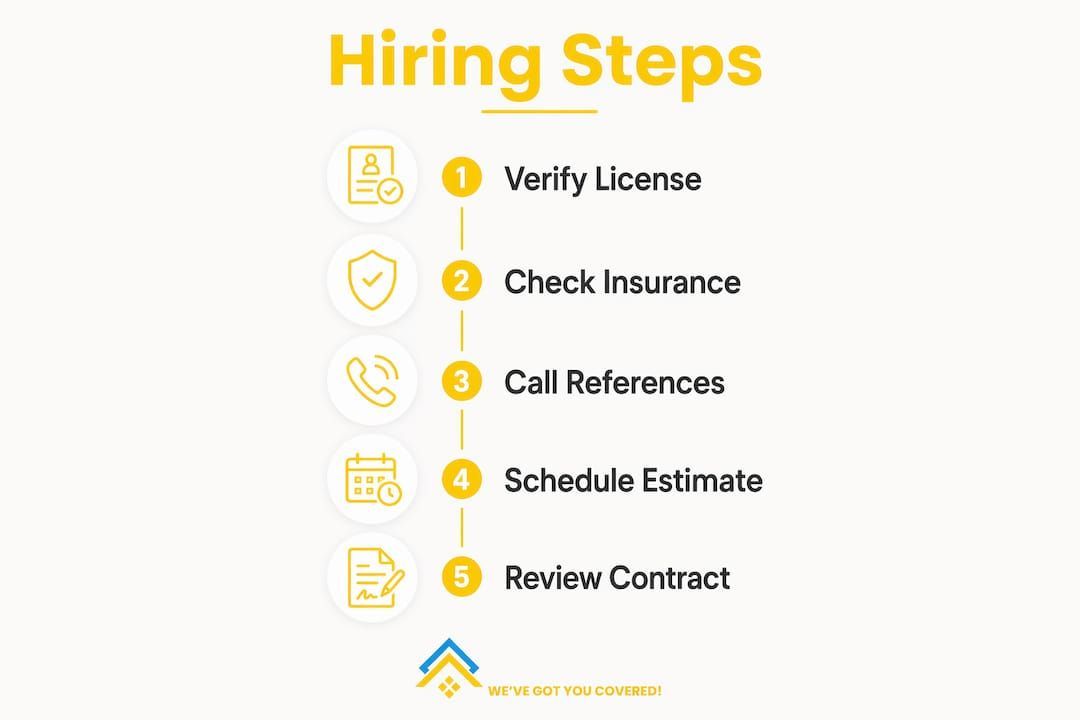
Step What to check
License verification Confirm number and type on state board website
Insurance confirmation Call insurer directly to verify active coverage
Written bid review Labor, materials, taxes, payment terms, warranty
Permit confirmation Contractor pulls and manages all required permits
Contract review Scope, timeline, payment schedule, warranty terms

Common pitfalls when hiring roofing contractors

The most expensive mistake homeowners make is hiring an unlicensed contractor to save money upfront. The short-term savings disappear fast when a failed inspection requires tearing out and redoing the work.

Watch for these specific pitfalls:

  • Mismatched license type. A general contractor license does not always cover roofing in every state. Confirm the license category covers your project type before work begins.
  • Skipping reference checks. References are not a formality. They are your best source of real information about how a contractor performs under pressure.
  • Vague contract language. Phrases like "standard materials" or "completed in a timely manner" are meaningless in a dispute. Every term must be specific and measurable.
  • Ignoring insurance gaps. Some states do not require roofer licensing at all. In those states, insurance and references carry even more weight as your primary protection.
  • No written change order process. Any change to the original scope must be documented in writing. Verbal agreements about additional work create payment disputes.

"A contractor who cannot produce a license number, an insurance certificate, and three references on request is not a contractor you should hire."

Pro Tip: If a project stalls, work is substandard, or a contractor disappears, file a complaint with your state contractor licensing board and the BBB immediately. Both agencies have formal dispute resolution processes.

What I've learned from years of watching homeowners get this wrong

Homeowners consistently underestimate how much licensing nuances vary by region. I have seen property managers in states with no mandatory roofer licensing assume that any contractor with a business card is qualified. That assumption leads to failed inspections, denied insurance claims, and roofs that leak within two years.

The credential verification step feels tedious. Most homeowners skip it because they trust a neighbor's recommendation or a contractor's confident pitch. But a recommendation tells you about one person's experience. A license check tells you about the contractor's legal standing, complaint history, and coverage. Both matter. Neither replaces the other.

The other pattern I see constantly is homeowners who negotiate on price but not on contract terms. A lower bid with vague contract language is a worse deal than a higher bid with a detailed, enforceable contract. The contract is your only protection once work begins. Spend more time on it than on the price.

Regional climate also shapes what a qualified contractor looks like. In Sacramento and the surrounding areas, contractors need to understand heat exposure, UV degradation, and the specific code requirements that govern roofing in California's Central Valley. A contractor who works primarily in a different climate zone may not specify the right underlayment or ventilation for your conditions. Local experience is not a soft preference. It is a technical requirement.

— Cesar

Upstateroofingpros: licensed roofing services for homeowners who want it done right

Upstateroofingpros serves homeowners and property managers across Sacramento, Roseville, and nearby areas with fully licensed, insured, and manufacturer-certified roofing professionals. Every project starts with a thorough assessment of your property's needs.

Whether you need roof repair services, a full roof replacement, or a professional roof inspection to establish a baseline before hiring, Upstateroofingpros delivers detailed written estimates, handles all permits, and backs every job with clear warranty terms. The team holds manufacturer certifications including GAF, which means you get access to extended material and labor warranties that uncertified contractors cannot offer. Contact Upstateroofingpros to get a written estimate from a licensed professional who knows your local codes.

FAQ

What does it mean to hire a licensed roofing contractor?

A licensed roofing contractor holds a state-issued license, carries general liability insurance, and maintains workers' compensation coverage. These credentials prove legal authorization to perform roofing work and protect you from financial liability.

How do I verify a roofing contractor's license?

Search your state contractor licensing board's website using the contractor's license number. Confirm the license is active, covers the correct work category, and shows no disciplinary actions.

What happens if I hire an unlicensed roofer?

Hiring an unlicensed contractor can result in failed inspections, denied building permits, and voided manufacturer warranties. You may also be held liable for injuries that occur on your property during the project.

Do all states require a roofing license?

No. Some states do not require a specific roofing license. In those states, verifying insurance, references, and manufacturer certifications becomes your primary method of evaluating contractor quality.

What should a roofing contract include?

A roofing contract must include the full scope of work, material specifications, start and end dates, a payment schedule, and warranty terms for both labor and materials. Vague language in any of these areas creates risk for you as the property owner.

Key takeaways

Hiring a licensed roofing contractor requires verifying four core credentials, requesting detailed written bids, confirming permit handling, and signing a contract with specific, enforceable terms.

Point Details
Verify four credentials Confirm state license, liability insurance, workers' comp, and three references before hiring.
Match license type to project General contractor licenses do not always cover roofing. Confirm the category matches your job.
Get written bids Bids must include labor, materials, taxes, payment terms, and warranty details to be valid.
Confirm permit handling A licensed contractor pulls and manages all permits. Avoid any contractor who asks you to do this.
Review the contract fully Scope, timeline, payment schedule, and warranty must all be specific and measurable before you sign.

Recommended

Recent Posts

July 7, 2026
Discover the critical role of building envelope roofing. Understand how it impacts energy efficiency, indoor air quality, and the durability of your home.
July 5, 2026
Discover the role of roofing contractor license for protection against costly mistakes. Learn how it ensures safety and legality in roofing work.
July 3, 2026
Understand what does a roofing bid include. Get detailed insights into materials, costs, and timelines to protect your budget.
June 30, 2026
Explore the types of roofing insulation for commercial buildings. Discover how the right insulation can reduce energy costs and improve compliance.
June 26, 2026
Discover why roof maintenance reduces capital costs and saves you money. Prevent costly repairs with proactive inspections and repairs.
June 23, 2026
Discover why commercial roofs need coatings in 2026. Extend roof life, reduce cooling costs, and save on replacements. Learn more!
June 21, 2026
Discover why commercial roofs stay flat. Learn how this design impacts costs, space, and maintenance decisions for smart property management.
June 19, 2026
Discover what roof warranty covers and learn how to protect your investment. Avoid costly surprises with our comprehensive homeowner's guide.
commercial roof repair in sacramento
June 5, 2026
Discover why roof maintenance prevents downtime for property owners. Learn effective strategies to protect your investment and avoid costly damage.
tpo roofing companies in sacramento
June 2, 2026
Discover our comprehensive TPO roofing installation overview for 2026. Learn essential steps and tips for a successful, energy-efficient roofing project!
Show More